

GAMA's Q2 2026 data shows the industry shipping more premium metal to a buyer increasingly insulated from rates, while the piston buyer gets squeezed.
GAMA's second-quarter 2026 shipment report landed September 3rd, and the headline number is fine: 1,458 airplanes shipped through the first half of the year, up modestly from 2025's pace, with piston deliveries alone running at 786 units year-to-date. But the unit count is the least interesting thing in this report. The more useful question is what buyers are actually choosing once they show up with a checkbook, and the data is plain on that point: the market is moving upmarket, and it's moving faster than most people building financing products for it have adjusted to.
In November 2025, Textron Aviation announced it would end production of the Beechcraft Bonanza G36 and Baron G58, two of the longest-running nameplates in general aviation, with more than 24,000 combined deliveries since launch. The official reason was a sustained sales decline and a decision to redirect resources toward the Beechcraft Denali, the single-engine turboprop that's been in development since 2016 and is now sliding toward first deliveries this year following the GE Catalyst engine's February 2025 certification.
The GAMA numbers make the case better than the press release did. Bonanza and Baron shipments combined for exactly two units in Q1 2026 and two more in Q2, four airplanes, worldwide, across a full six months, for a platform that once anchored Beechcraft's piston lineup. That's not a soft quarter. That's a company that has already, functionally, stopped building these airplanes and is running out remaining orders while it waits for Denali certification to clear.
The trade being made is stark by price alone. A Bonanza or Baron new-build sold somewhere in the neighborhood of $1 million to $1.3 million depending on configuration. The Denali is expected to list around $6.4 million to $6.6 million, call it five times the price, for a buyer moving from piston to single-engine turboprop performance. Textron isn't just retiring two old airframes; it's reallocating its entire piston-adjacent product investment toward a buyer who can write a much bigger check. That's premiumization in one company's product roadmap, and it's not unique to Beechcraft. It's the same logic playing out across nearly every OEM's shipment mix this quarter.
It's worth asking whether this is a genuinely new phenomenon or the continuation of something that's been building for a while, because the answer changes how you should underwrite around it. Our read: premiumization is largely a COVID-era pivot that never unwound, and the clearest way to see that is to look at what happened in adjacent industries facing the identical supply-and-demand math at the identical moment.
Start with the mechanism. Through 2020 and into 2021, general aviation, like automotive and marine, saw a genuine surge in demand for personal, private transportation as buyers sought alternatives to shared and commercial travel, arriving right as global supply chains for engines, avionics, semiconductors, and raw materials seized up. That combination forced every manufacturer with capacity-constrained production into the same decision: when you can only build a fixed number of units regardless of demand, you build the ones that carry the best margin per constrained production slot. Selling a $6 million turboprop instead of a $1.2 million piston single, out of the same limited factory capacity, isn't a discretionary choice at that point. It is a strategic business decision to maximize yield.
The automotive industry ran this exact playbook in the open, and it's well documented. During the 2021 to 2022 chip shortage, automakers explicitly prioritized truck and SUV production over sedans, because those larger vehicles carry meaningfully better margins for only marginally higher production cost, loaded with technology and premium options that cost little extra to build but support real pricing power. What started as a supply-constrained emergency measure has since hardened into permanent strategy: Ford currently sells zero traditional sedans in the U.S. market, GM has redirected production toward full-size internal combustion engine trucks and SUVs while pulling back from weaker-margin EV programs, and cars overall made up just 17% of the U.S. market in 2025. Detroit didn't go back to sedans once the chip shortage cleared, because the margin math it discovered under duress didn't stop being true once the duress ended.
Marine tells the same story from a different angle. The recreational boating industry saw the identical COVID-era demand surge, and heading into 2026 it has settled into a genuinely two-tier market: premium yachts and sportfish boats, particularly in the 40-to-70-foot range, are behaving almost like a separate market entirely, with stable pricing, healthy late-model brokerage inventory, and buyers who are notably less rate-sensitive, more focused on fit, pedigree, and maintenance history than on financing terms. Entry-level and mass-market segments, by contrast, are the ones actually carrying overall unit volume in a mixed economic environment, with softer pricing and buyers who are exactly as rate-sensitive as you'd expect. That's premiumization by another name, in an industry with no regulatory or certification barriers to explain it away, which makes it a cleaner read on buyer behavior than aviation's own numbers, precisely because nothing about airworthiness certification is forcing the boat market to split the same way.
So the premise holds up, and holds up better than aviation's numbers alone would suggest: this isn't a story unique to airplanes, or to Beechcraft, or to this particular GAMA report. It's the same COVID-triggered reallocation toward higher-margin, lower-volume production that automotive and marine manufacturers made under identical constraints, in the same window, for the same reasons, and in all three industries, the buyer segment that emerged on the other side of it has proven more insulated from supply-chain shocks and broader economic cycles than the volume buyer left behind. Once a manufacturer discovers that a wealthier, less rate-sensitive customer base is both willing to pay up and less likely to disappear in the next downturn, there's little competitive pressure to go back.
We built the "Aircraft Demand vs. the Macro Factors" tool on our Market Coverage Hub page, the 31-year panel that lets you toggle gas prices, housing starts, CPI, the 5-year Treasury, and corporate profits against piston, turboprop, and jet unit shipments, because treating "the aircraft market" as a single, undifferentiated market obscures more than it reveals. It's actually three markets, each tracking a different piece of the macro picture, and the analysis is incomplete if it only contrasts the two ends of that spectrum.
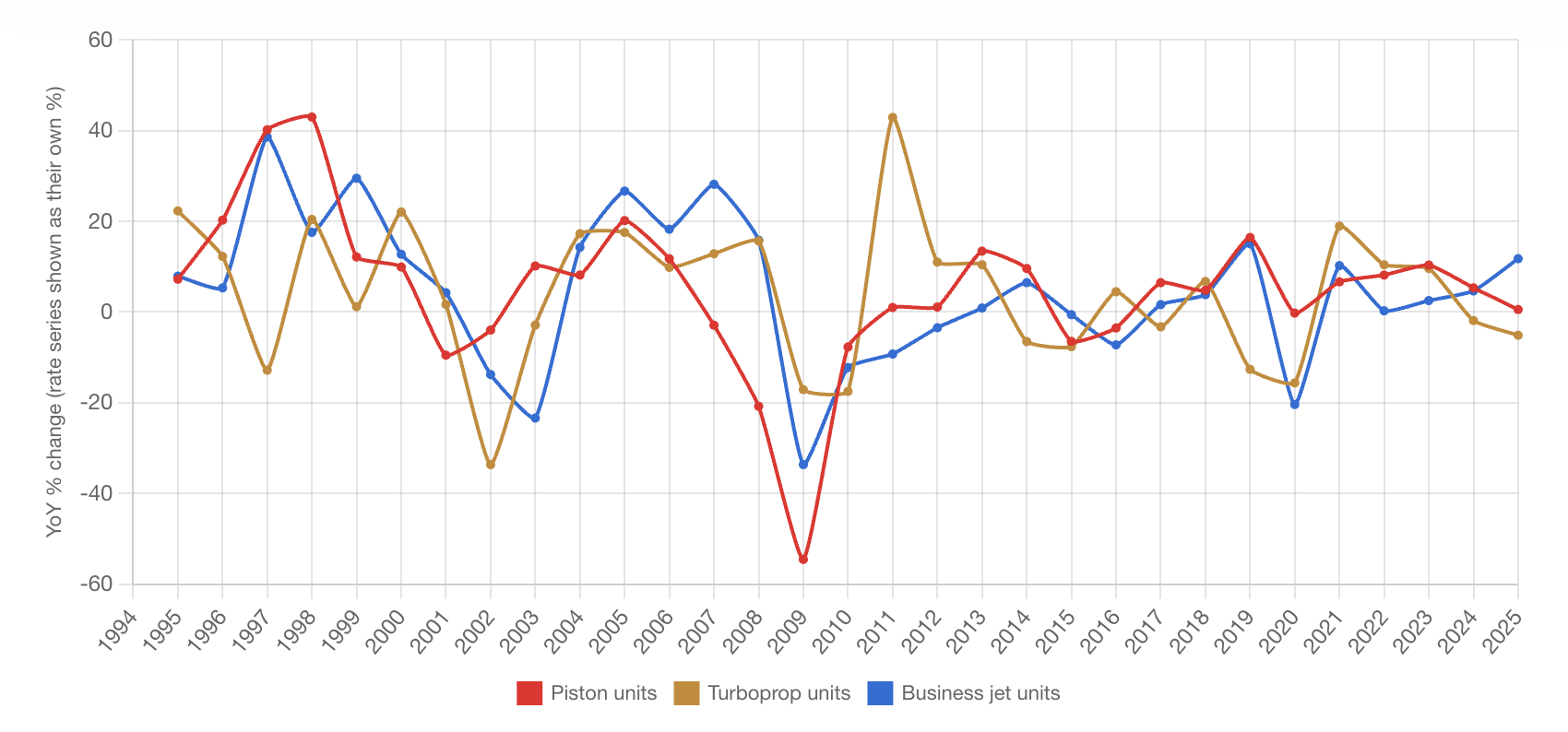
Run piston units against housing starts and gas prices and the correlation holds up reasonably well: a Skyhawk buyer feels a gas price spike and a soft housing market in something like the way a boat or RV buyer does, because the piston buyer is disproportionately a household financing a real share of the purchase, exposed to the same discretionary-spending pressures as any other big-ticket consumer good.
Run business jet units against the same two series and the correlation is weak to nonexistent. Jet buyers track corporate after-tax profits, S&P 500 returns, and household net worth concentrated at the top of the distribution, series that move on a completely different rhythm than what shows up at the pump or in a new-home permit, and that's before accounting for how much of today's jet demand is being driven by buyers financing for tax and liquidity-management reasons rather than because they can't write the check outright.
Turboprop sits in the middle, and it deserves its own read rather than being folded into either extreme. Turboprop buyers are disproportionately owner-operators and small businesses, agricultural operations, charter fleets, regional utility and cargo operators, which makes the segment genuinely sensitive to corporate profits and fuel costs in a way piston buyers aren't, but considerably less sensitive to household-level pressures like housing starts and gas-pump prices than piston buyers are, since the purchase is typically justified against a business's operating economics rather than a household budget. It's also the segment most directly in play in the Beechcraft story above: the Denali is a turboprop, and Textron's bet is that turboprop demand is durable enough, and turboprop buyers insulated enough from the piston buyer's macro exposure, to justify walking away from the piston lineup entirely.
That three-way split is the whole premiumization story in miniature. The piston segment remains genuinely rate- and macro-sensitive. The segment growing fastest in dollar terms, jet, and increasingly turboprop, is increasingly buyers who are considerably more insulated from the exact macro variables that used to move the whole GA market together. If you're underwriting or forecasting off a single blended "aircraft market" indicator, you're averaging three buyer populations that no longer move together, and the average tells you less every quarter.
Layer the OEM order backlog data from this quarter's business aviation module on top of the shipment numbers and the split gets sharper still. Three of four major manufacturers are showing sustained multi-period backlog growth: Bombardier up 51% since year-end 2024, Gulfstream up 22%, Embraer up 5%, against preowned jet inventory that's already historically tight across every segment (heavy jet listings running at 5.2% of fleet against a 7.0% ten-year average; light jet at 7.0% against 8.9%). Longer new-aircraft wait times are pushing buyers who don't want to wait toward the preowned market, and preowned inventory doesn't have much slack left to give. That's a textbook seller's market, and it's compounding: the tighter new-build backlogs get, the more buyers get pushed into an already-thin used pool, the tighter that pool gets.
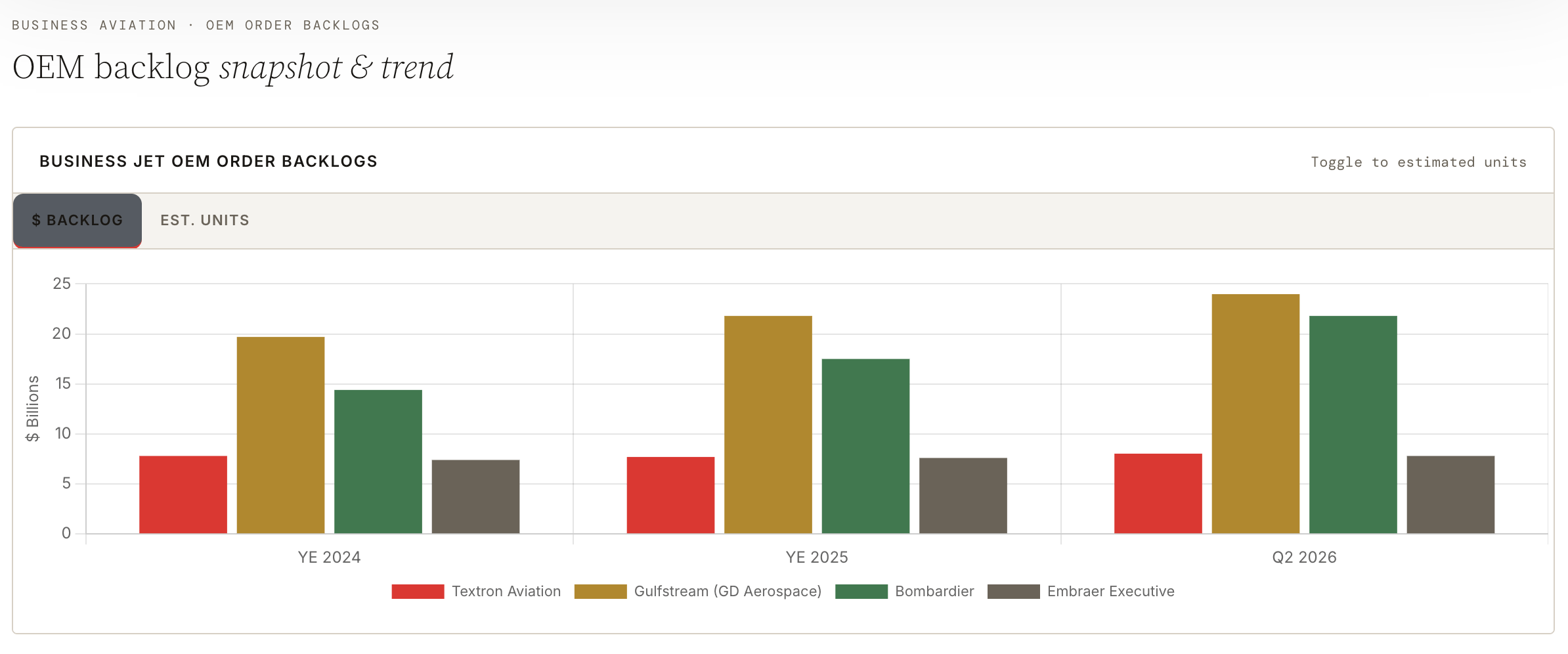
It's worth naming directly what that backlog growth actually represents on the ground: manufacturers are visibly jockeying for position with the buyer who can pay up, and it shows in more than the shipment mix. We've seen a real increase this year in inbound interest from OEMs and dealers asking how to get creative, higher-visibility placement in front of our readership, a direct reflection of how competitive the fight for the affluent buyer's attention has become as backlogs lengthen and everyone chases the same shrinking pool of buyers who aren't waiting two years for delivery. We see the identical dynamic playing out in Firecrown Media's marine media properties, where builders serving that same 40-to-70-foot premium buyer are asking the same question about visibility and access. It's a brief aside, not the point of this piece, but it's a useful data point on where the affluent buyer's attention is actually being contested right now, and it's happening across more than one of the affluent-lifestyle categories we cover.
The piston side of the used market is telling a different, quieter story: not tightness from strong demand, but tightness from a supply pipeline that hasn't caught up. Q1 and Q2 2026 combined for 786 new piston shipments, a genuine surge relative to recent history, but that surge hasn't worked its way into used inventory yet, because new airplanes take time to filter down to trade-ins and because the buyers stepping up to new piston aircraft right now skew toward the same higher-spec, more expensive end of the segment (SR22T and SF50 deliveries running well ahead of base SR20 volume at Cirrus this quarter, for instance). The result: preowned Cirrus and late-model Skylane prices remain elevated even as new shipments climb, because the piston buyers with financing constraints, the ones who'd normally be shopping the used market when new prices run up, are the ones getting squeezed out first.
Medium jet doesn't fit that pattern, and we'd rather flag the contradiction than paper over it. Backlogs are tight there and preowned inventory is tight there too, the same setup that's pushing prices higher everywhere else in this piece. Instead, asking prices in that segment are down roughly 25% year over year. That's exactly the kind of split signal that's been making this market so hard to read from the outside lately: one corner insists prices are climbing, another insists they're falling, and both are technically right depending on which segment you're standing in. We don't have a clean explanation for medium jet yet, and we'd rather say that directly than force it into the same story as everything else on this page. We're watching it, and we'll report back once the picture clears.
There's a quieter mechanical problem sitting underneath all of this that's worth surfacing for anyone financing into this market: appraisal methodology has been lagging the actual price action. Standard appraisal practice weights recent comparable transactions against a trailing window, often the preceding three, six, or twelve months of closed sales and listings. In a market where prices are climbing as fast as backlog scarcity and premiumization are pushing them right now, a trailing window systematically understates what a buyer is actually going to pay today, because the comps it's built on are, by construction, several months stale in a market that hasn't stood still. We're seeing appraisers across the industry respond to exactly that problem by refining their models to weight the most recent transactions more heavily, precisely because the traditional trailing-data approach has been producing appraised values that come in too low relative to real transaction prices, a genuine, mechanical mismatch, not a sign that the higher prices themselves are somehow illegitimate.
That matters for how you should read the price run-up in this piece. It's less a permanent repricing of the asset class than an outlook question, and the outlook points toward this easing only when demand against the currently limited supply base actually wanes, which, historically, happens for one of two reasons, and usually both together: OEMs and the used market catching up on supply, and financing conditions tightening enough to cool demand from the buyers whose purchases are actually optional. On the second point, the piece that follows this one in the series lays out in detail why we expect rates to be heading up rather than down from here, which is exactly the kind of condition that has historically taken the edge off backlog-driven price spikes like this one. That would be a genuinely good outcome for the industry as a whole, appraised values catching up to reality, backlogs normalizing, medium jet's odd pricing behavior aside, but it doesn't land evenly. A rate environment tight enough to cool demand at the top of the market lands hardest on exactly the buyer segment we've described throughout this piece as least insulated from it: the piston buyer, financing a real share of the purchase, for whom financing was never optional to begin with, and for whom higher rates are a direct affordability cost rather than a minor drag on an otherwise-discretionary decision.
For a lender, the premiumization trend is a demand-mix problem more than a demand-level problem. Total unit volume across piston, turboprop, and jet isn't moving dramatically. It's the average price per unit inside every category that's climbing, which means average loan size climbs even in a flat-unit environment, and underwriting that's calibrated to last cycle's price bands is going to keep getting surprised on the upside. It also means the piston segment, historically the segment most correlated with broad macro conditions and the segment most buyers actually finance a meaningful share of, is the one place where genuine affordability pressure is building fastest, a thread we'll pull on directly in the third piece in this series. If you want to see what that looks like against your own numbers before it shows up in a rate quote, our aircraft finance calculator is a good place to start.
The next installment looks at why the rate backdrop those piston buyers are financing into is more likely to get worse before it gets better, starting with what the Fed's new chairman actually said at Jackson Hole, and what the swing in CME FedWatch pricing from "probably a hold" to "probably a hike" inside a single week tells you about where the next 90 days are headed.
Sources: GAMA General Aviation Aircraft Shipment Report, 2026 Second Quarter (published September 3rd, 2026); Textron Aviation Bonanza/Baron production-end announcement, November 2025; AMSTAT business aviation market data, Q2 2026; FLYING Finance OEM Backlog Snapshot (company SEC filings and investor releases); FLYING Finance "Aircraft Demand vs. the Macro Factors" panel, 1994 to 2025 (GAMA, EIA, BLS, FRED); automotive industry margin and product-mix reporting on the 2021 to 2022 semiconductor shortage and its lasting effects on truck, SUV, and sedan production strategy, 2026; recreational marine industry Q1 2026 market reporting on premium-segment versus entry-level boat demand.
Talk to a specialist
Every aircraft and every buyer is a little different. Tell us how to reach you and a FLYING Finance specialist will follow up to talk through your aircraft, your numbers and your timing.
Prefer to call? (702) 757-1176