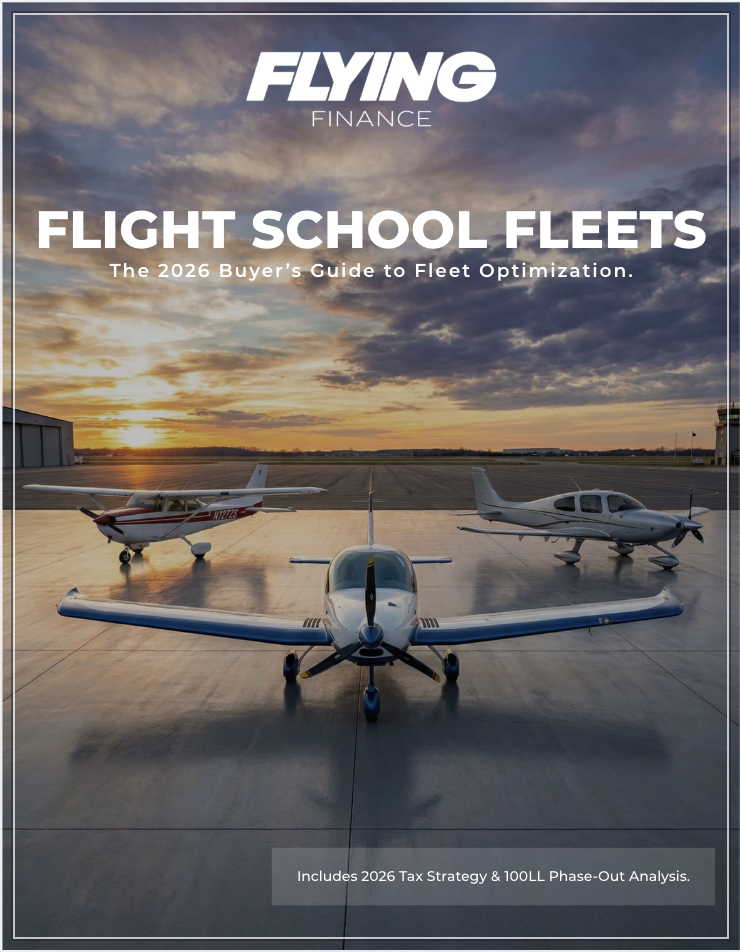
Fleet financing for Part 141 and Part 61 operations. Single aircraft or multi-aircraft fleets. Commercial use documentation. FLYING Finance has financed flight school fleets from a single 172 to a 10-aircraft Part 141 operation.
Flight school financing is one of the most specific conversations in aviation lending. You're not financing a personal-use aircraft — you're financing a revenue-generating asset in a commercial operation. The aircraft will be flown by students, maintained by A&Ps on a rigorous schedule, and operated under an FAA operating certificate. Lenders who don't understand that context apply the wrong framework. Lenders who do understand it are FLYING Finance's network.
A well-documented Part 141 operation with three years of financials, current operating certificate, and revenue history is a strong borrower profile. The aircraft is the collateral. The business is the context. Both matter.
FLYING Finance finances flight school aircraft across the most common training platforms: Cessna 172 and 182, Piper Archer and Cherokee, Diamond DA40 and DA42, Tecnam P92 and P2008, and Cirrus SR20/SR22 for advanced training operations. Single-aircraft Part 61 schools and multi-aircraft Part 141 academies both require commercial use documentation — the documentation depth scales with the transaction size.
The most important decision before applying is entity structure. The operating entity — whether that's an LLC, corporation, or sole proprietorship — must be the borrower and take title. Insurance must reflect commercial operations (flight instruction, rental). Revenue history or projections, student enrollment data, and operating certificate status all factor into the lender's underwriting of a flight school transaction.
These are the aircraft FLYING Finance finances most frequently for flight training operations.
The 172 is the training fleet standard — lenders know it intimately, values are stable, and parts/maintenance infrastructure is universal. Per-aircraft: ~$200K–$280K for late-model G1000 examples. Five-aircraft fleet: ~$1M–$1.4M. Fleet financing allows multiple aircraft to be structured under a single transaction in many cases. Cessna financing details.
Diamond aircraft dominate advanced and IFR training programs globally — the DA40 NG for single-engine IFR, the DA42 for multi-engine. Austro diesel engines require lender familiarity, and fleet financing for Diamond typically requires lenders with specific DA40/DA42 experience. Flight school use is explicitly understood by Diamond-familiar lenders. Diamond financing details.
The metal-and-carbon P2008 is the modern light sport fleet standard—burning just 4.5 gallons of Mogas or Avgas per hour with full Garmin G3X dual-screen panels. Operating with an S-LSA certificate, it secures the 7.37% LSA rate. Lenders love financing new P2008 lines because their turn-key factory support stabilizes residual value curves. Tecnam financing details.
Cirrus SR20 and SR22 aircraft are increasingly used by Part 141 schools offering glass cockpit, CAPS-equipped training — particularly university aviation programs. CAPS is viewed favorably from both a safety and collateral perspective. Commercial use documentation for Cirrus fleet transactions follows the same pattern as other commercial piston fleet financing. Cirrus financing details.
The Piper Archer is one of the most widely used IFR training aircraft — G1000-equipped variants are the standard for Part 141 instrument rating courses. The Piper Seminole PA-44 is the dominant multi-engine training platform in Part 141 programs nationwide. Both are certified piston at 6.60%. Commercial use documentation for Piper fleet transactions is well understood by aviation lenders who regularly see training fleet files. Piper financing details.
Some innovative Part 61 and EAA-affiliated flight training programs operate Van's RV-12iS aircraft — factory-built or builder-assist EAB platforms that serve as light, efficient, low-cost primary trainers. As EAB aircraft they finance at 7.44%. Fleet use of experimental aircraft requires lenders specifically experienced with commercial EAB operations — a niche within a niche that FLYING Finance has navigated. Build documentation quality is the defining collateral variable. EAB financing details.
The Bristell B23 Classic is increasingly used as a primary trainer in MOSAIC-forward schools — carbon fiber construction, Rotax 912 power, and a modern cockpit that prepares students for glass-equipped certified aircraft. As an S-LSA it finances at 7.37%. Bristell fleet transactions require lenders with platform experience; FLYING Finance routes to those specifically. MOSAIC's expansion of the LSA category makes Bristell's performance envelope more relevant for training programs stepping up from basic LSA trainers.
Sling Aircraft USA's factory-assist program has made the Sling 2 and TSi increasingly viable for flight training operations — particularly for schools building a modern, composite-construction fleet at accessible acquisition costs. The Sling 2 in S-LSA configuration finances at 7.37%; the TSi as EAB at 7.44%. South African-designed, U.S.-supported, and well-documented from factory-assist builds. Sling financing details.
Cirrus's new three-seat trainer pairs a turbocharged Rotax 916 iSC with full CAPS, ESP, and a Garmin flight deck — built specifically for Part 141 and collegiate flight programs. 13 flight schools have already ordered. U.S. deliveries begin 2027, so we're not quoting fleet terms yet — but if you're planning a fleet refresh around it, now's the time to start the conversation.
| Fleet configuration | Total cost | Down (15%) | Loan | Est. monthly |
|---|---|---|---|---|
| 1× Cessna 172S G1000 (single aircraft)6.60% / 20yr | $260,000 | $39,000 | $221,000 | $1,661 |
| 1× Diamond DA40 NG (single aircraft)6.60% / 20yr | $430,000 | $64,500 | $365,500 | $2,747 |
| 1× Tecnam P2010 / P2008 (Modern LSA Trainer)7.37% / 20yr | $195,000 | $48,750 | $146,250 | $1,167 |
| 5× Cessna 172S fleet (combined)6.60% / 20yr | $1,300,000 | $195,000 | $1,105,000 | $8,304 |
Flight school fleet transactions: plan 5–7 days for credit decision. Pre-submission call recommended for transactions over $500K or multiple aircraft.
FLYING Finance is part of Firecrown Media — publisher of FLYING Magazine, AvBuyer, AVweb, and Kitplanes. These resources are independent editorial content, not sales materials.
Resources the FLYING Finance team references when evaluating market conditions and aircraft values in this category.
"Flight school fleet financing is one of the most specific conversations in aviation lending. I know what lenders need for Part 141 operations, single-aircraft schools, and everything in between."
Closed & Funded — Certified Piston
Recent legislation has equipped flight students with the ability to use 529 college savings funds for flight training.
We understand the maintenance cycles of flight school environments and the high resale value of proven training airframes.





We understand your P&L. Let’s build a financing structure that supports your growth and your students’ success.
Talk to a specialist
Every aircraft and every buyer is a little different. Tell us how to reach you and a FLYING Finance specialist will follow up to talk through your aircraft, your numbers and your timing.
Prefer to call? (702) 757-1176