Daher TBM Financing · TBM 960 · TBM 910 · TBM 940 · Pre-Owned · Built in Tarbes, France
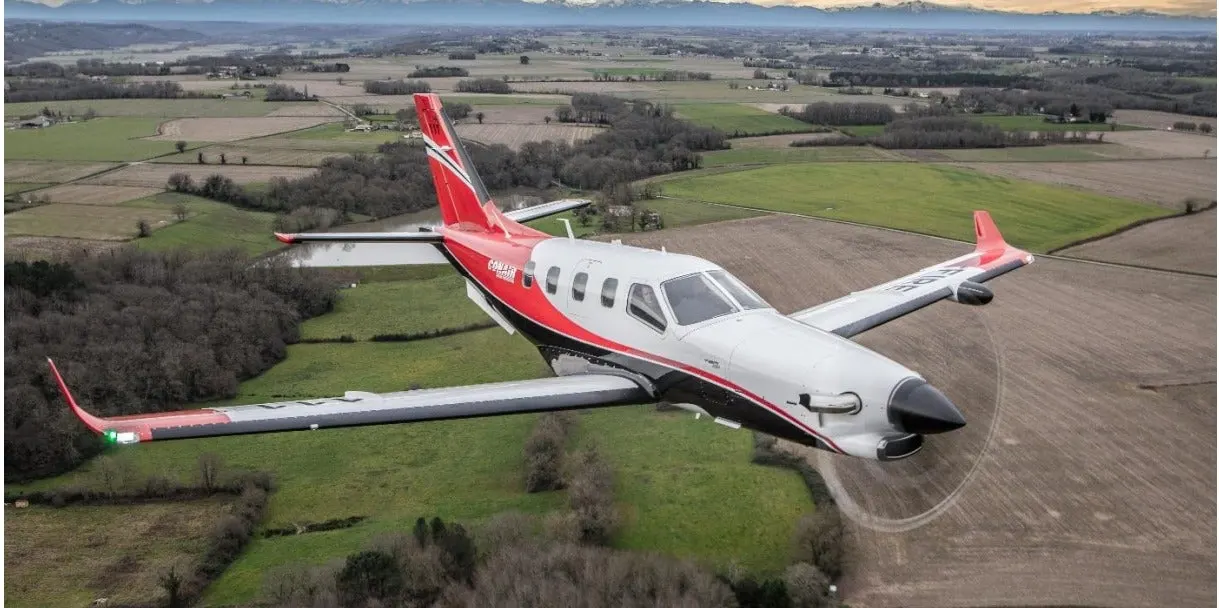
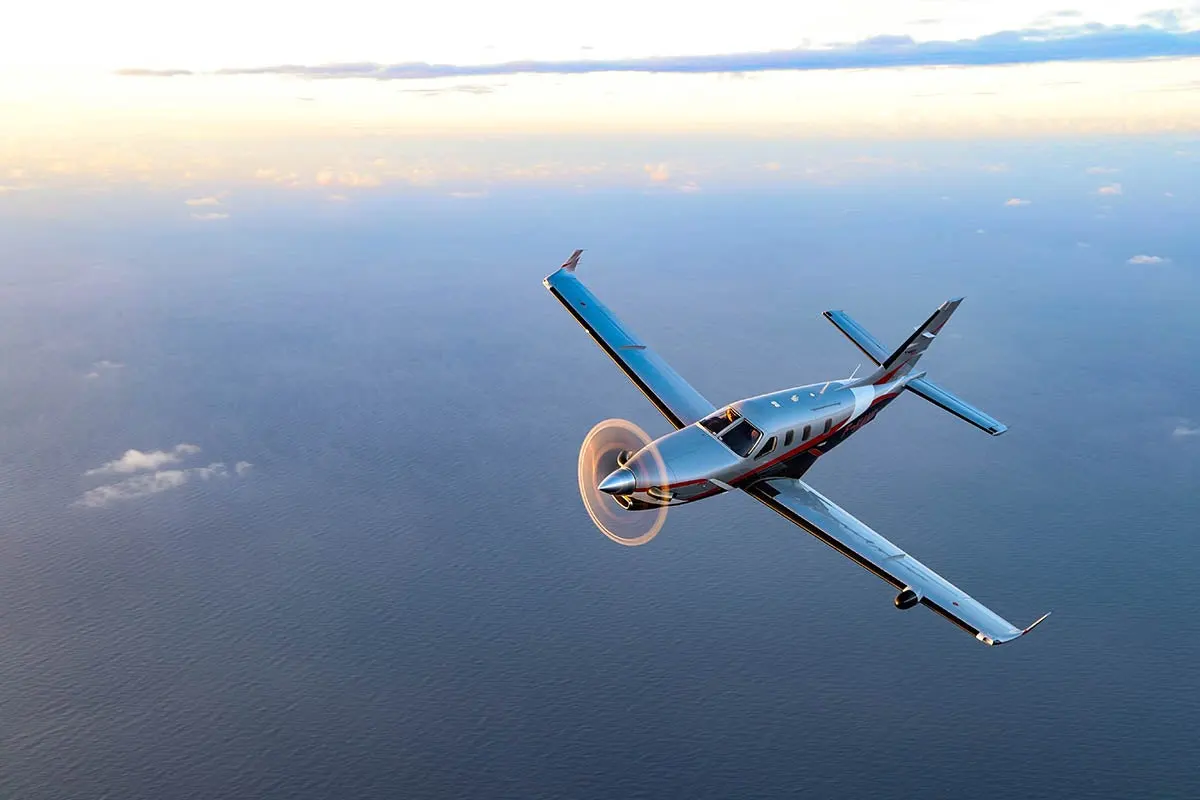
The TBM 980, Daher’s current-production flagship, holds the speed record for single-engine turboprops: 330 KTAS at 28,000 feet, 1,730 nm range, and a Garmin G3000 Prime flight deck with HomeSafe emergency autoland. Daher continues building the TBM 960 alongside it at a lower price with the standard G3000 suite. Either one is the aircraft owner-pilots step into when they want jet performance without a jet operating budget. FLYING Finance has placed more turboprop loans than any media brand in general aviation.
Who buys a TBM
Unlike the PC-12, which attracts a mix of charter operators, fractional programs, and corporate flight departments, the TBM is primarily an owner-pilot aircraft. The buyer is typically a high-net-worth individual (a physician, attorney, entrepreneur, or executive) who holds an instrument rating, flies 200–400 hours annually, and wants the fastest practical way to cover 500–1,000 nm missions in a single seat.
Both the TBM 960 and TBM 980 cruise at 330 KTAS, faster than many light jets. For an owner-pilot flying 300+ hours per year on business missions, the time value of that speed is measurable. FLYING Finance borrowers financing TBMs frequently structure the aircraft as a business asset, capturing accelerated depreciation through bonus depreciation provisions. A $4.5M TBM 960 purchased before December 31, 2026 may qualify for significant first-year depreciation under current IRS rules.
The TBM’s operating cost is $1,800–$2,000 per hour all-in, including fuel, maintenance, and reserves. That compares favorably to the $2,500–$3,500/hour cost of operating a light twin-engine jet on comparable missions. For the owner-pilot comfortable with single-pilot IFR operations, the TBM represents the best performance-per-dollar in the turbine market.
The TBM 960 and TBM 980 include Garmin’s HomeSafe emergency autoland: a single button that, if the pilot is incapacitated, autonomously navigates to the nearest suitable airport, declares an emergency, and lands the aircraft. This technology materially changes the risk profile of single-engine IFR operations and has become a significant selling point for owner-pilots flying alone with family aboard.
The TBM 960 and TBM 980 Prestige cabin seats five passengers with electrically-dimmable windows, touchscreen environmental controls, ambient lighting, and individually-heated seats. Five exterior paint schemes, eight interior harmonies, and 40 additional leather shades. Configured for comfort on the typical 2–3 hour owner-pilot mission at altitude.
The TBM family
The current flagship. Garmin G3000 Prime with three 14-inch touchscreens (first on any TBM), Starlink Mini satellite connectivity, pilot door, 100W USB-C at every seat. Same PT6E-66XT engine and 330 KTAS performance as the 960. Deliveries began January 2026.
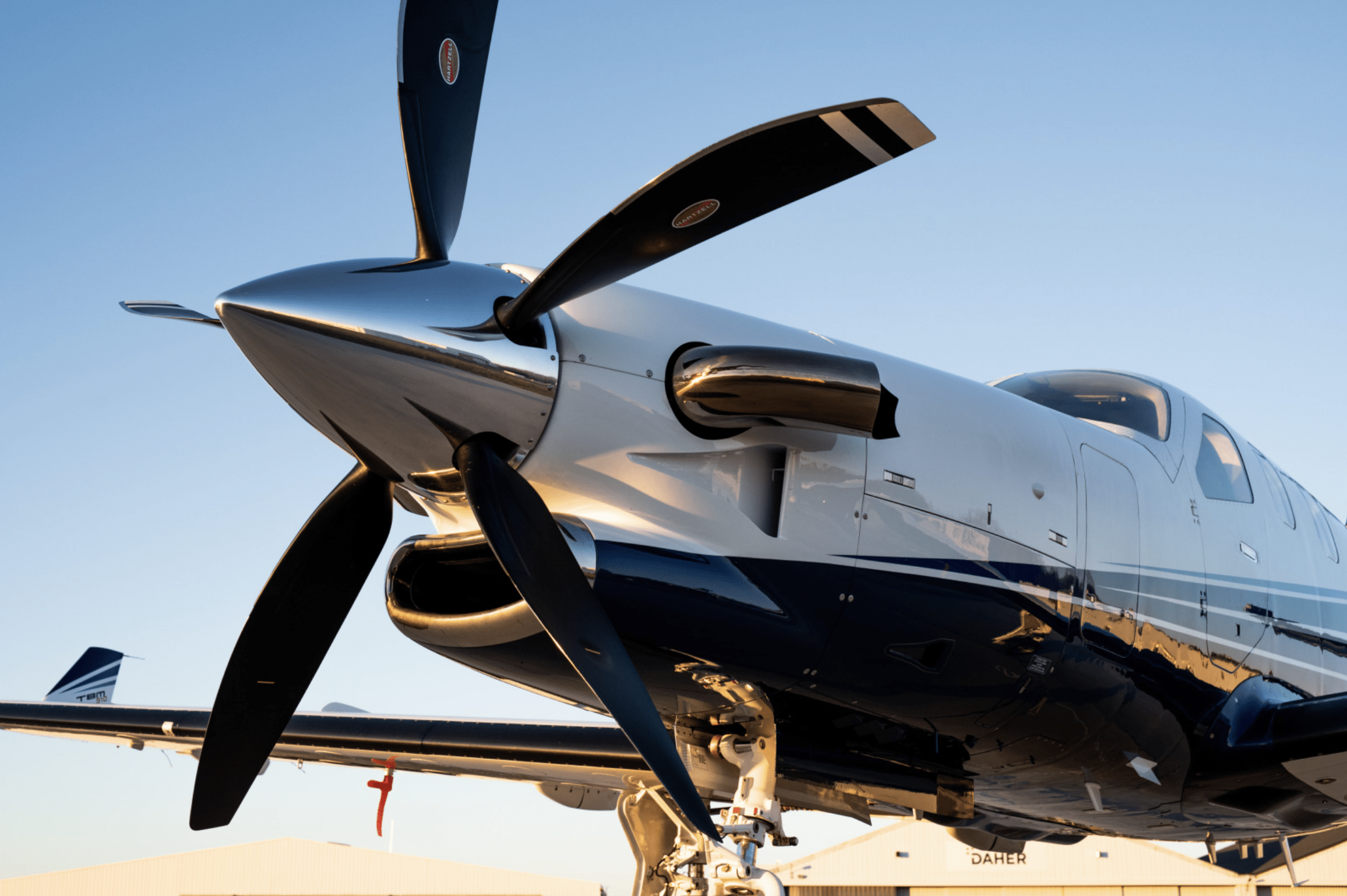
The flagship. Single-lever FADEC, Garmin G3000, HomeSafe autoland, Hartzell Raptor 5-blade composite prop. Climbs to 31,000 ft in 18 min 45 sec.
Same performance envelope as the 960 at a lower price. No FADEC but same G3000 cockpit and speed profile. Strong value for the buyer who doesn’t need single-lever operation.
Introduced auto-throttle and ESP (Electronic Stability Protection). Concurrent with the 910: the 940 emphasized automation, the 910 connectivity. Finance on equivalent terms.
First TBM with the G3000 integrated flight deck. Still 330 KTAS, 31,000 ft ceiling. Entry-level price into the G3000 cockpit without the 960 premium.
Introduced the 4-blade composite prop and PT6A-66D that brought the platform to 330 KTAS. Pre-2014 TBMs are a different financing conversation; contact us for older variant availability.
Also from Daher · Built in Sandpoint, Idaho
The Kodiak is Daher’s STOL utility platform: unpressurized, 10-seat, built for unimproved strips, floats, and multi-mission operations. 390 delivered worldwide. The buyer profile is government agencies, remote operators, and utility fleets rather than owner-pilots. Financing is available on turboprop terms; the structure differs from a TBM transaction. Contact us for Kodiak-specific financing →
TBM financing runs on single-engine turboprop terms. The platform’s consistent resale market and strong owner-pilot community mean lenders are familiar and competitive on TBM collateral across generations.
Daher Aircraft · TBM since 1990, Tarbes, France
The TBM story begins with a joint venture between Socata (a subsidiary of Aerospatiale) and Mooney Aircraft in 1987. The TBM 700 (“TBM” standing for Tarbes-Mooney) first flew in 1988 and entered service in 1990 as the world’s fastest single-engine piston-to-turboprop conversion. Socata eventually became the sole shareholder, and the Mooney link faded, but the name remained. By the time Daher acquired Socata in 2008, the TBM had established itself as the benchmark for owner-pilot turboprops.
The progression from the TBM 700 to the 850 to the 900 series was a steady refinement: more power, better avionics, composite props. The TBM 900 (2014) was the first to carry the Hartzell composite propeller and the PT6A-66D that finally unlocked 330 KTAS. The 930 (2016) brought the Garmin G3000 to the cockpit. The 940 and 910 (2019) added auto-throttle, Electronic Stability Protection, and the Nexus FMS. The 960 (2022) completed the digital transformation with FADEC and HomeSafe autoland: the first single-engine turboprop to land itself.
As of December 2025, 1,294 TBMs have been delivered worldwide. The owner-pilot demographic has remained consistent across every generation: high-net-worth professionals flying solo on business missions who want the capability of a light jet without the crew requirement or operating cost. That consistent buyer profile is one reason the TBM pre-owned market is liquid and well-priced across all generations.
Tax strategy · December 31, 2026 deadline
Aircraft placed in service before December 31, 2026 may qualify for bonus depreciation under current IRS rules, potentially allowing a significant first-year deduction on the full purchase price of a qualifying business aircraft. On a $4.5M TBM 960 or $6M PC-12 NGX, the tax impact can exceed the total interest cost of the loan. FLYING Finance is not a tax advisor. Structure the transaction with your CPA and an aviation tax specialist before closing. Read our bonus depreciation guide → For a look at how ownership structuring, leasing, and sales tax questions actually play out at closing, see +[Me]: What Happens After the Price Is Set, FLYING Finance's CFO on the deal.
How the financing works
Most turboprop lenders apply a cap where the aircraft’s age plus the loan term cannot exceed 25 to 30 years. A 2010 TBM 850 is 16 years old in 2026. At a 25-year cap, the maximum term is 9 years. At a 30-year cap, you get 14 years. Both are workable structures on an aircraft priced around $1.5M–$2M. Contact us before making an offer on any TBM older than 2005.
Most TBM lenders strongly prefer enrollment in Pratt & Whitney’s ESP engine maintenance program. An off-program TBM is financeable but faces additional scrutiny. If you are buying off-program, get a cost-to-enroll estimate and factor it into your offer price: some sellers will negotiate on this basis. Enrollment is standard on most current-generation TBMs.
A TBM 960 or TBM 980 purchased and placed in service before December 31, 2026 may qualify for bonus depreciation under current IRS rules, potentially allowing significant first-year deductions on a $4.5M–$5.8M aircraft. This is a significant financial consideration for business owners. FLYING Finance is not a tax advisor. Work with your CPA, but we can connect you with aviation tax specialists who close these transactions regularly.
Standard turbine documentation: current airframe, engine, and prop logbooks; annual inspection within 12 months; FAA registration; hull insurance binder; signed purchase agreement; and title search. Most TBM transactions close in 3–4 weeks from executed purchase agreement to funding. Pre-buy from a Daher-authorized service center is standard on any turbine transaction.
Many turboprop owners offset operating costs by dry leasing their aircraft to other qualified pilots when they are not flying it themselves. Done correctly, a dry lease arrangement can recover $30,000–$80,000+ annually on a PC-12 or TBM. Done incorrectly, it creates FAA compliance exposure and can void your insurance. Understanding the rules before you finance matters: some lenders restrict lease arrangements without prior approval. Read our dry lease guide →
Single-engine turboprop rates for well-qualified borrowers on a TBM 960 start at 6.53% as of June 2026, on a 20-year amortization with 15% minimum down. The TBM’s strong owner-pilot buyer base and consistent pre-owned liquidity mean lenders are competitive on this platform.
Rate and term structures are nearly identical for well-qualified borrowers: both are single-engine turboprops with strong pre-owned markets. The PC-12 has more total aircraft delivered (2,000+ vs 1,294 TBMs) and a broader buyer base including charter operators and fractional programs. The TBM is the faster aircraft. The financing decision should follow the mission, not the rate sheet.
Yes, if the aircraft is used for business purposes and the purchase is structured correctly. A TBM 960 purchased and placed in service before December 31, 2026 may qualify for bonus depreciation under current IRS rules. FLYING Finance is not a tax advisor. Structure the transaction with your CPA, but we can connect you with aviation tax specialists who work these transactions regularly.
Most turboprop lenders apply a cap where aircraft age plus loan term cannot exceed 25 to 30 years. A 2010 TBM 850 is 16 years old in 2026. At a 25-year cap, the maximum term is 9 years. At a 30-year cap, 14 years. Contact us before making an offer on any TBM older than 2005; we will run the numbers before you invest in a pre-buy.
Most TBM lenders strongly prefer enrollment in Pratt & Whitney’s ESP engine maintenance program. An off-program TBM is financeable but will face additional lender scrutiny. If buying off-program, get a cost-to-enroll estimate and factor it into your offer price.
Both cruise at 330 KTAS and carry the Garmin G3000. The 960 adds FADEC (single-lever power control), HomeSafe autoland, and the Hartzell Raptor 5-blade prop. The 910 saves roughly $500K–$700K on the pre-owned market. If HomeSafe and FADEC matter to you, and they should if you fly solo with passengers, the 960 premium is justified. If you are stepping into the platform for the first time on a budget, the 910 delivers identical speed and range.
Tools & resources
Model a TBM transaction, check current turbine rates, or compare platforms before you commit.
From the flight deck
The TBM 960 is the most-reviewed single-engine turboprop in GA media. Here is the coverage worth reading before you buy.
Amelia · FLYING Finance AI specialist
Talk to a specialist
Tell us how to reach you and a FLYING Finance specialist will follow up to talk through rates, down payment and timing for the aircraft you have in mind.
Prefer to call? (702) 757-1176
Related market data: see piston aircraft transaction index, GA aircraft shipments (GAMA) and aircraft loan rates vs. the 5-year Treasury, updated from primary sources.
Specs, current pricing, and financing terms for each TBM generation we finance: