
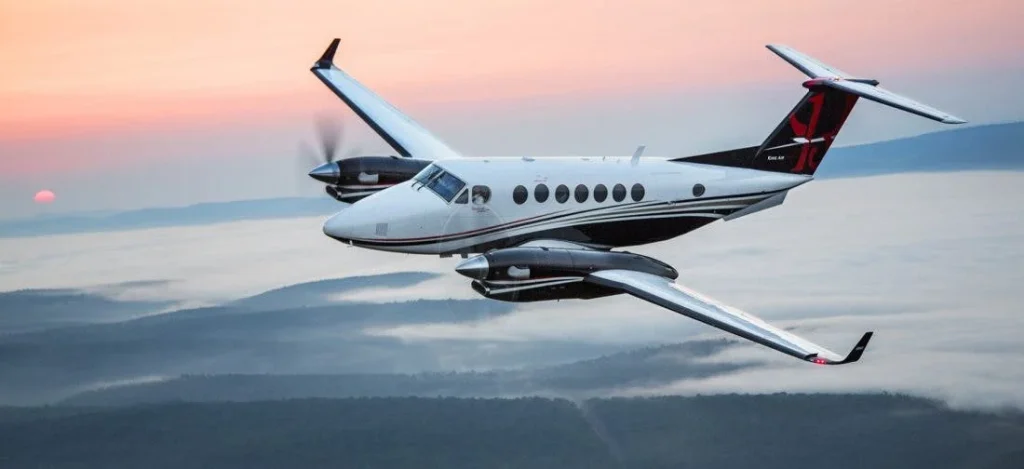
The turbine Beechcraft line — the King Air twin turboprop family in continuous production since the 1960s, and the new Denali single. Engine programs, age formulas, and a specialized lender pool. This is the turbine conversation, done properly.
The King Air is the most financed turboprop family in aviation. In continuous production since the 1960s, with thousands flying and a resale market that lenders can model against decades of transaction history, King Air collateral enjoys lender familiarity that few aircraft of any category can match. The King Air 260 and 360 finance at the turboprop rate of 6.75%.
Textron's newest turbine Beechcraft is the Denali — a clean-sheet single-engine turboprop powered by the GE Catalyst engine, the first new clean-sheet turboprop engine in decades. The GE Catalyst received FAA engine certification in February 2025. Aircraft type certification is expected in 2026, with service entry to follow — though the program has experienced repeated timeline delays since its 2015 announcement, and buyers should confirm the current delivery timeline directly with Textron Aviation. The Denali finances at the turboprop rate as well, with FLYING Finance routing transactions to lenders who can underwrite new-type collateral correctly.
What makes turbine underwriting different: engine program enrollment matters as much as credit, and for many lenders, an age-plus-amortization formula governs how long a loan for a given airframe supports. How you intend to use the aircraft — pure Part 91, business use, or charter offset — also changes the structure. Each gets its own section below.
New-production twins, the deep pre-owned market, and the new single. All finance at the turboprop rate; each underwrites with its own emphasis.
The current light-twin King Air — dual Pratt & Whitney Canada PT6A-52 engines, nine seats, 316-knot cruise, Garmin G1000 NXi panel with autothrottle. The step-up aircraft for owner-pilots leaving high-performance pistons and the workhorse of corporate flight departments that don't need a jet. Engine program enrollment is standard and underwrites favorably.
The flagship King Air — PT6A-60A engines, 11 seats, 312-knot cruise, Garmin G3000 panel with autothrottle and a full-width cabin that competes with light jets on comfort while beating them on field performance and operating cost. The 360 is the King Air that flight departments keep when they evaluate the jet and decide the runway math wins.
The pre-owned King Air market is the deepest in the turboprop world — B200s and 250s in the light-twin class, 350s and 350is up top. Value and financeability turn on engine program status, airframe hours, and the age formula. A program-enrolled 2015 250 is straightforward; a 2000 350 requires routing to lenders whose age caps accommodate it. Both are financeable — the routing is the skill.
Read the indepth review in We Fly: Beechcraft King Air 200 with Autoland
A clean-sheet single-engine turboprop powered by the GE Catalyst — FAA engine certification February 2025, aircraft type certification expected in 2026 with service entry to follow. The certification program has amassed more than 3,330 flight hours across three test aircraft. Designed to compete with the Pilatus PC-12: high useful load, Garmin avionics, turboprop efficiency below King Air 360 money. As a new type, lender familiarity is still building — FLYING Finance routes Denali transactions to turboprop-experienced lenders who can underwrite new-type collateral, with PC-12 and TBM lenders the natural pool. Confirm delivery timing directly with Textron Aviation.
Computed at today's turboprop rate, 20-year amortization, 15% down. Age-formula constraints may shorten available terms on older airframes.
| Aircraft | Market price | Down (15%) | Loan amount | Est. monthly |
|---|---|---|---|---|
| King Air 260 (new)6.75% / 20yr — turboprop | $4,200,000 | $630,000 | $3,570,000 | $26,282 |
| King Air 250 (pre-owned, 2018)6.75% / 20yr — turboprop | $2,800,000 | $420,000 | $2,380,000 | $17,521 |
| King Air 350i (pre-owned, 2014)6.75% / 20yr — turboprop | $4,600,000 | $690,000 | $3,910,000 | $28,785 |
| King Air 360 (new)6.75% / 20yr — turboprop | $8,100,000 | $1,215,000 | $6,885,000 | $50,686 |
| Beechcraft Denali (new — delivery TBD with Textron)6.75% / 20yr — turboprop | $6,750,000 | $1,012,500 | $5,737,500 | $42,239 |
Engine programs, the age formula, use structure, and the new-type question.
Engine program enrollment is standard on King Air transactions. JSSI and ESP Gold (Pratt & Whitney) are the primary programs for the PT6A series. An unenrolled King Air is an open-ended maintenance liability that affects lender appetite and your budget. Enroll at purchase — a GLADA-affiliated broker will often recommend it before you close.
Most turboprop lenders cap aircraft age plus amortization at 23, 25, or 30 years. A 2005 King Air 350 is 21 in 2026 — a two-year loan under a 23-year cap, a 20-year amortization under a 30-year cap. Vintage King Airs are financeable; knowing which lender's formula fits your airframe is part of what FLYING Finance does.
With type certification expected in 2026 and deliveries to follow, Denali lender familiarity is still developing. PC-12 and TBM lenders are the natural pool — similar mission, price range, and collateral profile. FLYING Finance routes Denali transactions to turboprop-experienced lenders as delivery data builds.
A King Air flown for business under Part 91 finances at 80–85% LTV with terms up to 20 years, and business-use documentation strengthens any file above $1M. Bonus depreciation makes the year-one tax math compelling — see the bonus depreciation guide for the December 31 placed-in-service math.
Planning to offset costs by chartering the aircraft when you're not flying it? Charter use changes the loan — hour caps, LTV constraints, and different insurance. It's workable when structured upfront and painful when discovered mid-underwriting. The full treatment: Part 91 ownership with limited charter offset.
15% minimum on standard transactions. Commercial-use structures and Denali purchases may see 20% given higher loan values and — for the Denali — limited transaction history on the new type.
Aircraft details withheld for client privacy.
FLYING Finance is part of Firecrown Media — publisher of FLYING Magazine, AvBuyer, AVweb, and Kitplanes. Independent editorial for turbine buyers at every tier.
"The King Air is the best-understood turbine collateral in aviation, and the Denali is the newest. I know engine programs, the age formula, and what changes when charter enters the picture. Ask me anything."
Talk to a specialist
Tell us how to reach you and a FLYING Finance specialist will follow up to talk through rates, down payment and timing for the aircraft you have in mind.
Prefer to call? (702) 757-1176
Specs, current pricing, and financing terms for each King Air variant we finance: