
Why upgrade from a Cirrus SR22T? As announced following the release of our 2026 Cirrus SR22 Buyer’s Guide, the SR22 series continues its unbroken reign atop the General Aviation Manufacturers Association (GAMA) delivery charts, with Cirrus celebrating its 11,000th SR Series delivery and the G7+ generation pushing the boundaries of what a piston single can achieve. Safe Return Emergency Autoland, now standard on the SR22 G7+, represents the first FAA-certified autoland system for a piston aircraft, a technological leap that has redefined the safety calculus for owner-pilots. At speeds of 213 KTAS and with a service ceiling of 25,000 feet, the turbocharged SR22T remains the undisputed champion of its class.
And yet, for a growing segment of operators, that class is no longer sufficient.
At Flying Finance, we see both sides of the acquisition equation daily. Within the last month alone, our team closed and funded financing on aircraft that ranged from a 1950 Navion B to a 2022 Piper M350 and a brand new Tecnam P2008 MkII, and included a Beechcraft Bonanza, Cessna 182T and Cirrus SR22T. All of these airplanes represent exceptional choices for their specific mission profiles. However, we also see a recurring pattern among our most active business clients. It is a phenomenon we have begun to call Piston Fatigue.
Don’t worry, piston fatigue is not a mechanical issue. Cirrus, Piper, Beechcraft and Cessna, and Tecnam make incredible aircraft. Piston fatigue is an operational issue. It manifests when a 200 hour per year business operator realizes that their $1.2 million asset has suddenly become the primary bottleneck in their professional life. It shows up when you have to cancel the third flight in a single month because of an icing forecast that your TKS system cannot safely handle for the duration of the route. It appears when the oxygen cannulas come out for the fourth consecutive leg above 12,500 feet and your passengers begin to wonder if this is truly preferable to the airlines, because it feels like a medical ward.
To understand the upgrade path, we must first look at the benchmark. Why would an owner upgrade from a Cirrus SR22T? The answer usually involves a fundamental mismatch between the capabilities of the aircraft and the demands of a growing business mission. When pressurization, useful load, and all weather dispatch reliability become non-negotiable requirements, even the world’s best selling high performance piston reaches its operational limits. It’s an efficiency calculation that increasingly favors the aircraft with a PT6A up front.
For the business owner flying 200 or more hours annually across regions where ice, altitude, and passenger comfort dictate the success of a trip, the turbine transition is not an indulgence. It is a logical efficiency calculation. This is where the emotional and physical reality of the piston ceiling begins to take hold.
Fatigue appears the moment the oxygen cannulas come out. At Flying Finance, we have a very specific saying for our clients: cannulas are for patients, not passengers. When you are flying a high net worth client or your family across the Rockies or even along the East Coast, handing them a plastic tube for their nose does not feel like private aviation. It feels like medical transport. Suggest it to a young child or grandchild and that trip is done before you reach level flight. It is the moment the utility of the aircraft is called into question and is the moment your passengers start questioning how adventurous the flight might become.
This fatigue also manifests as TKS Timer Anxiety. While many pistons are certified for flight into known icing (FIKI) via TKS weeping wing systems, there is a massive gap between what is legal and what is logical for a mission. TKS relies on a finite tank of glycol fluid. In a serious icing encounter, you are not just flying the airplane. You are watching a countdown timer. Once that fluid is gone, your protection is zero.
Furthermore, piston engines simply lack the excess horsepower required to climb out of an icing layer with speed. Ice accumulation on unprotected areas like antennas, landing gear, and step ups adds drag that a piston engine often cannot out muscle. A TKS equipped piston is a system designed for escaping ice. A boot equipped turbine like the Piper M500 or the Daher TBM is a system for defeating it. With 500 or more horsepower and pneumatic boots, you do not sit in the layer and hope for the best. You climb through it at 2,000 feet per minute to reach the clear sky at FL250.
Finally, there is the Velocity Gap. It crystallizes when a 500 nautical mile mission transforms a productive day trip into an exhausting overnight. At 170 to 180 knots, you are at the mercy of the headwinds. At 260 to 330 knots, you’re back in time for dinner.
In a market flooded with high performance singles, the Piper M350 stands alone. It is the only pressurized piston aircraft currently in production. This distinction fundamentally separates it from every other piston powered competitor. For pilots and business operators searching for the ceiling of piston performance, the M350 is the definitive option.
The M350 delivers on the promise its lineage established decades ago with the Malibu platform. Powered by the turbocharged Lycoming TIO-540-AE2A producing 350 horsepower, the aircraft cruises at 213 KTAS, similar to the five passenger SR22T, while carrying up to six occupants at an expanded useful load of 1,308lbs for an additional 322nm (up to 1,343nm), in genuine comfort. But the headline specification is the 5.5 psi differential cabin pressurization system. This allows the M350 to cruise at its maximum approved altitude of 25,000 feet while maintaining a cabin altitude of approximately 8,000 feet. No oxygen masks. No cannulas. Just move about the cabin comfort above the weather.
The advantage of pressurization is hard to overstate. Every unpressurized piston, regardless of how powerful or fast it may be, mandates supplemental oxygen for any sustained flight above 12,500 feet. For business operators frequenting routes like Atlanta to Miami, Dallas to Nashville, Charlotte to DC, or Denver to the Golden State, the entire mission profile changes when you can climb above convective weather and icing layers. By removing the physical fatigue of oxygen equipment and offering radar and FIKI as standard, the M350 shifts from a regional airplane into a professional tool.
The interior of the M350 reinforces this professional positioning. The aircraft’s club seating allows rear passengers to face each other, transforming the pressurized cabin into a mobile conference room. With built in work tables and USB charging ports at every seat, the aircraft is ready for business at 25,000 feet.
Safety features elevate the M350 further into professional territory. Standard equipment includes the GWX 75 Weather Radar. This is a genuine airborne radar system that provides real time storm cell tracking, not satellite delayed imagery. Standard flight into known icing certification with pneumatic de-icing boots means the M350 can legally and safely dispatch into weather conditions that ground its unpressurized competitors. Unlike TKS systems that offer finite fluid reserves, the M350 boots operate mechanically off engine bleed air. This provides essentially unlimited duration icing protection.
The Garmin G1000 NXi three screen avionics suite delivers the advanced safety systems modern pilots demand, including Synthetic Vision Technology and Electronic Stability Protection. The GFC 700 autopilot includes the Level Mode button, which is a single push that returns the aircraft to straight and level flight during a disorientation event. It will not bring you all the way to a safe landing, but it will help you regain control after a turbulent throw.
Flying Finance recently closed funding on a Piper M350 for an operator who understood exactly what this aircraft represents. That transaction was not about acquiring another piston single. It was about breaking through the ceiling into pressurized, radar equipped, and FIKI certified capability without the turbine price tag. With a 2026 market price around $1,575,000 and variable operating costs near $450 per hour, the M350 delivers a light turbine experience on a piston budget.
If you have already read our 2026 Aircraft Market Guide, you may have seen that once an operator has moved past both the SR22T and the M350, the roadmap branches into a few distinct paths. In the current 2026 market, we have identified a specific investment sweet spot in each of those paths. It is the three to seven year old vintage. Purchasing in this window allows a business owner to avoid the massive 30% depreciation hit that comes with a new aircraft while still benefiting from current generation avionics and factory support. As you will see, the sweet spot differs depending on which aircraft, largely due to the specific maintenance and warranty considerations.
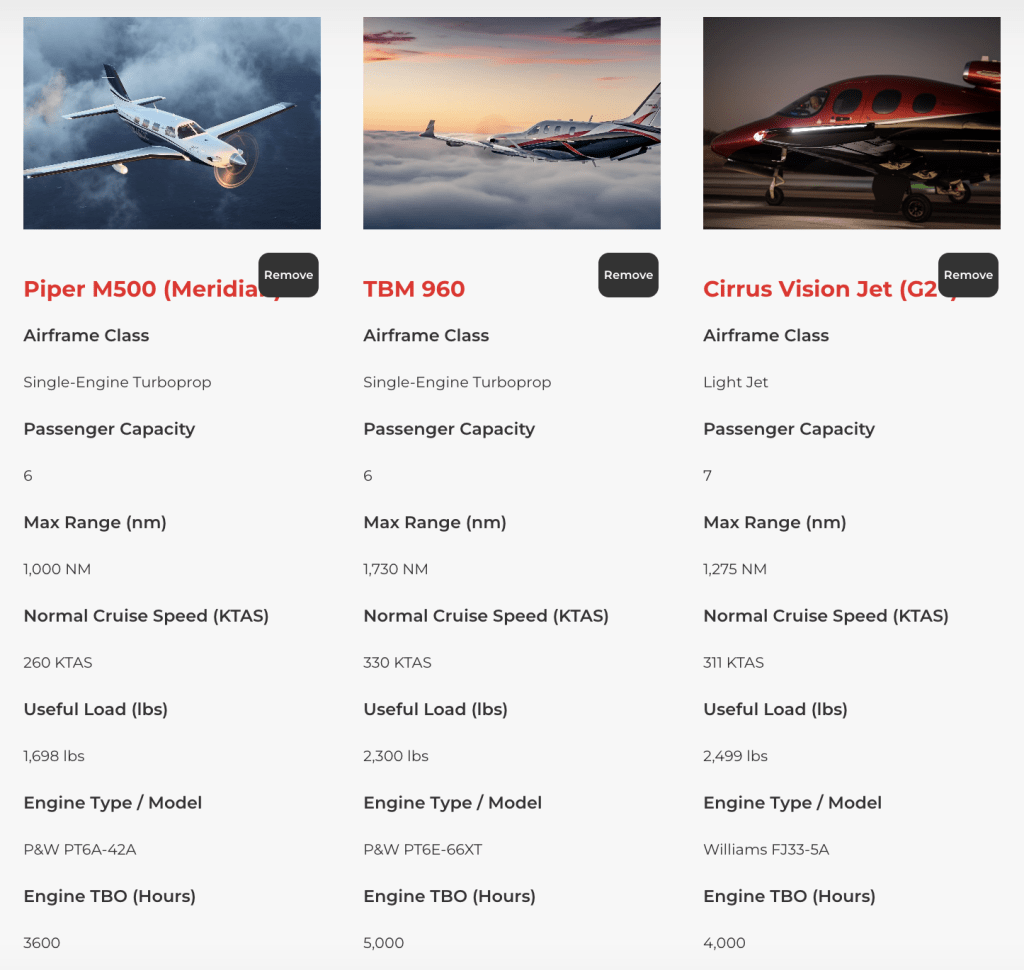
This roadmap typically includes the Cirrus SF50 Vision Jet for those who prioritize safety and lifestyle, or the Piper M500 and M600 for those who want pure business efficiency. At the top of this roadmap sits the Daher TBM. With a cruise speed of 330 knots and the ability to fly at FL310, it is the corporate missile of choice for those who need to cover large distances quickly.
To help our clients understand these tradeoffs, we often point them to resources like our own Matt Herr’s analysis on When an Upgrade from Piston to Turboprop Makes Sense. It is all about matching the capital to the mission.
The signing of the One Big Beautiful Bill Act (OBBBA) on July 4, 2025, transformed the financial landscape for business aviation. By permanently restoring 100% bonus depreciation, the federal government provided a massive incentive for operators to invest in more capable and reliable aircraft. For any business owner looking at a 2026 aircraft purchase, this tax provision is the single most important variable in the capital equation.
Under the OBBBA, the ability to immediately expense the full purchase price of an aircraft applies to both new and pre owned assets. This is a critical distinction. It allows an operator to acquire a used Piper M500 or a TBM 930 and claim the same aggressive tax shield as if they had purchased a factory fresh model. The objective of the legislation was to stimulate capital velocity, and in the aviation sector, it has succeeded brilliantly, with the General Aviation Manufacturers Association (GAMA) data showing a record $35.7 billion in global aircraft billings in 2025. Within that figure, all segments outperformed the pre-pandemic 2019 levels, with piston aircraft shipments reaching 1,782 units and a 12% year over year increase in jet sales reaching 854 units.
The core of this strategy lies in the Marginal Tax Rate Arbitrage. When you deduct the full value of a multi-million dollar asset in a single year, you are essentially receiving an interest free loan from the government for a significant portion of the purchase price. There is the saying you cannot escape death or taxes, so this is not free money, but deferred and interest free. Consider the math for a high net worth individual operating through a passthrough entity.
With a top marginal federal tax rate of 37%, the calculation looks like this:
Tax Savings = Purchase Price x 0.37
If you acquire a $2,150,000 Piper M500, your Year One tax reduction is $795,500. When you compare this against a standard 20% down payment of $430,000, the tax savings actually exceed the cash required at closing. The aircraft is effectively paying for its own down payment and providing additional working capital for your business.
For a C-Corporation, the rate is lower at 21%, but the principle remains the same:
Tax Savings = $2,150,000 x 0.21 = $451,500
Even at the corporate rate, the tax shield covers the entirety of the initial cash outlay. This is the mathematical foundation of our “expensive is cheaper” thesis. By moving to a more expensive turbine, you generate a larger absolute tax deduction. This deduction can then be used to offset the active income of your primary business, provided you have structured the ownership correctly.
Disclaimer: The tax savings calculations and strategies presented above are for illustrative and informational purposes only and do not constitute formal tax or legal advice. Aircraft tax compliance is exceptionally complex and subject to strict Internal Revenue Code requirements, including the “Qualified Business Use” thresholds of Section 280F and the passive activity grouping rules of Treasury Regulation Section 1.469-4. Furthermore, state-level “decoupling” from federal OBBBA bonus depreciation rules may significantly alter the final tax outcome depending on your jurisdiction. Individual results will vary based on your specific marginal tax rate, business use percentage, and financing structure. You should not act upon this information without a comprehensive review of your specific situation by qualified aviation tax counsel and a certified public accountant.
While 100% bonus depreciation is a powerful tool, it must be paired with an intelligent acquisition strategy. At Flying Finance, we often see our clients steer toward the three to seven year old aircraft window. This is what we call the Investment Sweet Spot.
The logic is simple. A brand new aircraft suffers its most significant value drop the moment it leaves the factory. By the time an airplane reaches its fifth year, that initial steep depreciation curve has flattened significantly. However, a five year old turbine is still a modern machine. It typically features current generation avionics, it is often still under some form of engine or airframe warranty, and it has a well documented maintenance history.
Take the Piper M500 as an example. A new model might command a premium price, but a 2019 or 2020 model provides the same PT6A power and pressurized comfort for a much more attractive capital entry point. Assuming 300 hours per year, a six or seven year old airframe may have just had its Hot Section Inspection at 1,800 hours, be past its propeller overhaul (year 6) and still have plenty of fuel to burn before the ten year inspections and hose replacements.
The same holds true for the Cirrus SF50 Vision Jet G2. Buying a mid-vintage G2 that is 6-8 years old allows you to access the G3000 avionics suite, most likely plenty of room before TBO at 4,000 hours, and the safety of a parachute system that is squarely between having just replaced the time-limited components (year 6) and still having some runway before the required repacking at year ten, while letting the first owner absorb the initial depreciation.
For the high performance mission, the 2016 or 2017 TBM 930 remains a dominant choice. These aircraft are corporate missiles, capable of 330 knots, and while nine or ten years puts the aircraft right at its most expensive airframe inspection, you might find that the propeller and PT6A engine have recevently been overhauled. By targeting this specific age range, you are maximizing your potential tax benefit (“Tax Alpha”) while minimizing your exposure to further market value drops. You are essentially buying an asset that has already reached its stable valuation floor.
The greatest tax shield in the world is useless if you cannot actually claim it against your active income. This is the primary hurdle for many business owners. The buy the aircraft hearing it will be able to be written off at tax time, only to find the aircraft did not meet the business utilization threshold or that the tax benefit is soley passive income, leaving no protection against active income tax liability.
The IRS generally classifies aircraft ownership as a passive activity unless the owner can prove material participation. The standard for material participation is often 500 hours of personal involvement per year. For a CEO who flies 150 hours annually, this creates a major problem. Their massive depreciation deduction becomes a passive loss, which can only be used to offset other passive income.
The solution is the Leasing Entity Purchase Structure (Dry Lease) combined with a Grouping Election.
Under Treasury Regulation 1.469-4, a taxpayer is permitted to group multiple trade or business activities together as a single activity if they form an appropriate economic unit. By creating a separate LLC to own and lease the aircraft, and then dry leasing that aircraft to your primary operating business, you can group the two activities. Since you are already materially participating in your primary business (presumably working well over 500 hours a year), the aircraft activity is swept into that same active bucket.
The structure requires a Non-Exclusive Dry Lease. This is a critical legal distinction for both the IRS and the FAA. In a dry lease, the lessor provides the aircraft but not the pilot. Your operating business must take full operational control. It must hire the pilots, pay for the fuel, and manage the maintenance. This ensures the arrangement is not seen as an illegal charter operation.
When executed correctly, this structure allows the 100% bonus depreciation to flow through to your personal tax return as an active loss, assuming records are maintained and actual usage is predominantly for business. It can then be used to wipe out the tax liability on the income generated by your main business. This is how you turn an airplane into a strategic financial asset. You can read more about these nuances in our guide to The Secrets Behind Dry Leasing and Wet Leasing.
Transitioning to a turbine and implementing a complex tax structure requires more than just a willing pilot. It requires a defensive posture from your financial team. Before you move forward with an acquisition, your CFO or CPA should verify the following points:
Breaking the piston ceiling is a significant milestone in any pilot or business owner’s journey. It represents a move toward higher professional standards, increased safety, and unparalleled efficiency. Whether you are moving into a Piper M350 to secure pressurized comfort at the top of the piston world, or stepping up to a TBM 930 to dominate your regional market, the capital structure is what makes the flight possible.
At Flying Finance, our goal is to help you model the mission before you ever sign a purchase agreement. We believe that an informed operator is a successful operator. We recently helped a client bridge this gap by funding their M350 transition, and we are ready to do the same for you.
Our team, led by Kimsey Bell and Jackson Moore, specializes in the technical nuances of aviation finance. We don’t just look at credit scores; we look at mission profiles and tax strategies.
If you are ready to see how the numbers work for your specific business, we invite you to use our Aircraft Ownership Cost Tool. It is designed to give you a preliminary look at the real world costs and benefits of the upgrade path. Once you have your heading, reach out to us or start your application at FlyingFinance.com. We will help you build the structure that turns your next aircraft into the ultimate business tool.
Stop dreaming and start flying. Our streamlined underwriting process is designed specifically for the modern light sport market and can have you flying in just a few days.