

A Guide to Unlocking Tax-Advantaged Savings for FAA Pilot and Mechanic Certificates under Public Law 119-21.
26 U.S.C. § 529(f): 529 funds may be used for the benefit of a designated beneficiary for qualified postsecondary credentialing expenses incurred in the pursuit of a recognized postsecondary credential, including any occupational or professional license issued or recognzied by a State or the Federal Government.
Historically, 529 plans were tethered to “Title IV” institutions—essentially accredited universities. Unless a flight program was part of a degree-granting college, the IRS viewed flight training as a “non-qualified” expense. Parents who withdrew funds for a local Part 141 or Part 61 flight school faced income taxes on the earnings plus a 10% federal penalty.
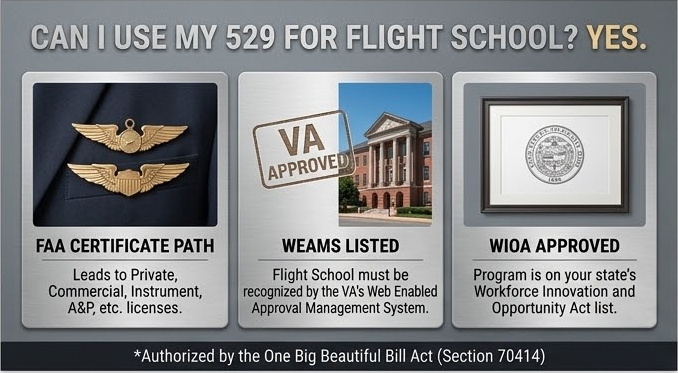
Section 70414 dismantled this restriction by amending IRC § 529 to create a new category: Qualified Postsecondary Credentialing Expenses (QPCE).
Under this new federal framework, a program qualifies if it meets at least one of four tests:
Because FAA pilot and mechanic certificates are federal occupational licenses, they now explicitly constitute a valid use of 529 funds.
For decades, aspiring pilots faced a frustrating financial paradox. A university student could use tax-advantaged 529 savings to study philosophy, art history, or virtually any academic discipline. Yet an aspiring aviator at a dedicated flight school was often barred from using those same funds to earn their wings.
That barrier collapsed on July 4, 2025, when the One Big Beautiful Bill Act (H.R. 1) was signed into law. Buried within this sweeping legislation was Section 70414, a provision that fundamentally rewrote the rules governing 529 plans and flight training. For the aviation industry, it represents the most significant shift in student financing since the post-WWII GI Bill.
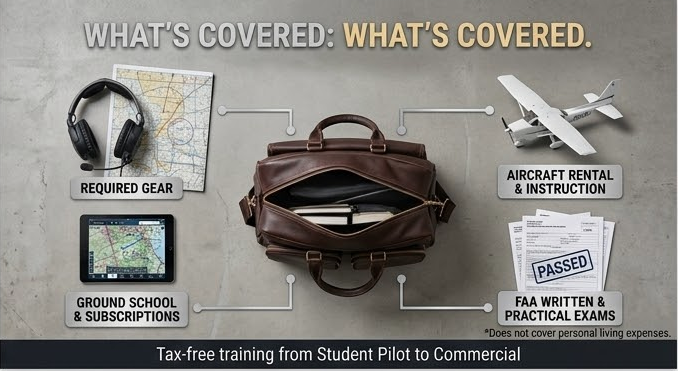
The Act is intentionally broad, designed to cover the high “all-in” costs of modern aviation training. Eligible expenses now include:
Note: The law does not cover personal living expenses such as housing, meals, or health insurance. These remain non-qualified.
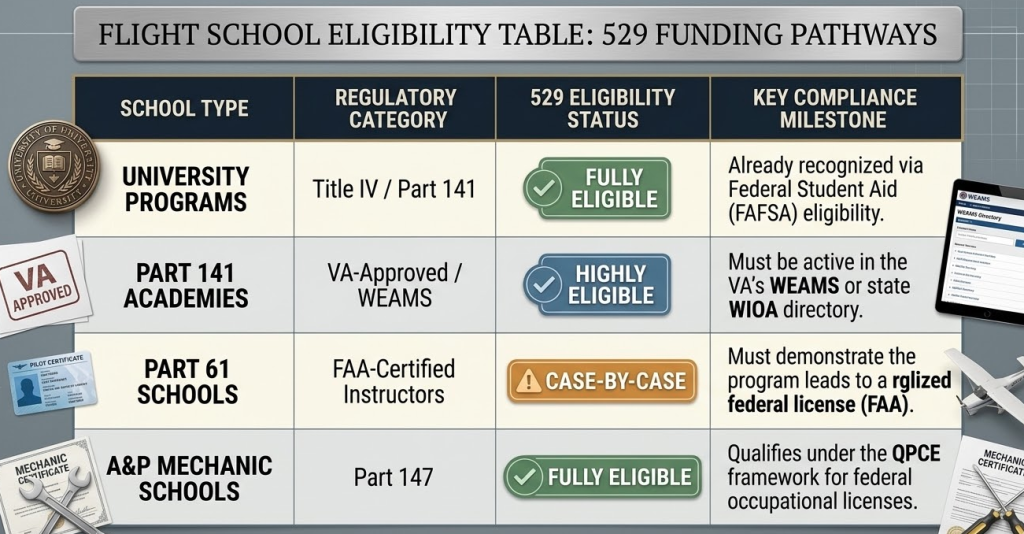
The 529 expansion is driving increased enrollment for eligible flight schools. Is your fleet ready?
A: No, the 2026 law specifically covers vocational training leading to credentials.
A: Yes, as it is a federally recognized license.
A: Use IRS Form 1099-Q, but always consult a CPA for state-specific conformity.